One Genome, Many Biological States
Why the harder problem in epigenomics is no longer measuring the epigenome, but interpreting it.

The human body contains roughly 37 trillion cells, and nearly all of them share essentially the same genome, give or take the occasional mutation. Yet cells in your brain, liver, and bones look and behave completely differently, carrying out specialized functions ranging from electrical signaling and metabolism to building the mineralized structures of our skeletons.1
The genome represents the full space of biological programs available to an organism, however, it is the epigenome that governs which of those programs are active in a given cell. In this way, a shared genome can give rise to the remarkable diversity of cell types, tissues, and biological states that make up a complex organism.
This is what makes epigenomics so interesting. While sequence tells us what a biological system can do, the epigenomic state helps tell us what it is doing now, how it got there, and potentially what it will do next.
Identical twins offer a striking example. Though they begin life genetically identical, studies have shown that their epigenomes diverge over time as differences in environment and experience accumulate. Each twin increasingly reflects their individual biological history rather than just their underlying genetics.2
There is also growing evidence that some of these effects can echo across generations. Some of the best-known examples come from famine cohorts, where severe nutritional stress has been associated with persistent epigenetic changes and, more provocatively, with health outcomes in subsequent generations.34
The Hype and the Reality
Spend too much time online, though, and the cultural zeitgeist would suggest that epigenetics is the key to reversing aging, erasing your grandmother’s trauma, or rewriting your biology with the right morning routine.
The reality is both less mystical and more interesting.
Epigenetic marks are dynamic and mechanistically involved in gene regulation, development, cell identity, and disease. But a single mark or epigenetic pattern is not automatically causal. Finding a difference between two biological states does not necessarily tell you what created it, whether it matters, or what will happen if you change it.
And this is where the field runs into an interesting problem: our ability to measure the epigenome has advanced faster than our ability to interpret it.
Epigenomics Is Starting to Deliver
That gap between measurement and understanding should not be mistaken for a lack of progress. Quite the opposite.
Epigenetic therapeutics have already produced approved drugs targeting regulators such as DNMTs, HDACs, EZH2, and, more recently, menin, with revumenib receiving FDA approval for genetically defined leukemias in 2024 and an expanded indication in 2025.5
Methylation-based diagnostics have also reached meaningful commercial scale. GRAIL’s Galleri test uses cell-free DNA methylation patterns to detect signals from multiple cancers, with published real-world data now spanning more than 100,000 tests and an FDA premarket approval application under review.67
Perhaps most strikingly, programmable epigenome editing has now entered the clinic. In 2026, early human studies from Epicrispr and Tune Therapeutics reported initial evidence that targeted epigenetic modulation can alter disease-relevant biology without rewriting the underlying DNA sequence.89
The field is no longer just observing the epigenome. It is beginning to intervene in it.
And that progress makes the next bottleneck much clearer.
Measurement Is No Longer the Only Bottleneck
We are increasingly sophisticated in our ability to profile DNA methylation, chromatin accessibility, and histone modifications alongside downstream changes in transcription and protein expression. More recent advances have even enabled the measurement of multiple layers in a single experiment.
The harder problem is understanding how these layers interact, determining which changes actually matter, and predicting what happens when we perturb them.
Part of the reason is that biology is orchestrated chaos.
Cells are governed by thousands of interacting regulatory elements, feedback loops, signaling pathways, and environmental inputs operating across different timescales. The effect of any individual epigenetic mark depends heavily on context: where it occurs, which regulatory machinery is present, what state the cell is already in, and what happened to that cell before we measured it.
That last point matters more than it might seem.
From Snapshots to Trajectories
Most epigenomic experiments give us a snapshot of a system at a single moment in time. We compare state A with state B, identify what changed, and ask whether those differences explain the characteristic we care about.
That approach has taught us an enormous amount. But biology itself does not operate as a sequence of independent snapshots.
Biological state is path-dependent. Cells carry molecular memory of previous exposures, perturbations, and developmental decisions, and that accumulated history helps determine how they respond to what comes next. Two cells can look similar at one moment while being on very different trajectories, just as two apparently different states may represent different points along the same transition.
A snapshot tells us that two states are different. A trajectory asks how they became different, where they are headed, and what intervention could redirect them.
That shift matters because the effect of a perturbation depends on the state and history of the system receiving it. Changing the same regulatory element in two different cellular contexts may produce very different outcomes.
The more interesting problem, then, is not simply identifying what differs between two states. It is reconstructing how one state became another, predicting where the system is headed next, and identifying the interventions capable of changing that trajectory.
All considered, the simplest way to view epigenomics is as a living history of life’s experiences, exposures, and interactions, written over time onto biology. When viewed through this lens, epigenomics begins to look less like a catalog of correlations and more like a science of biological adaptation.
Footnotes
-
Bianconi E. et al. An estimation of the number of cells in the human body. Annals of Human Biology. 2013;40(6):463–471. DOI: 10.3109/03014460.2013.807878. ↩
-
Fraga M.F. et al. Epigenetic differences arise during the lifetime of monozygotic twins. Proceedings of the National Academy of Sciences. 2005;102(30):10604–10609. DOI: 10.1073/pnas.0500398102. ↩
-
Heijmans B.T. et al. Persistent epigenetic differences associated with prenatal exposure to famine in humans. PNAS. 2008;105(44):17046–17049. ↩
-
Vågerö D. et al. Paternal grandfather’s access to food predicts all-cause and cancer mortality in grandsons. Nature Communications. 2018;9:5124. ↩
-
FDA. FDA approves revumenib for relapsed or refractory acute leukemia with a KMT2A translocation. November 15, 2024; expanded to susceptible NPM1-mutant AML on October 24, 2025. ↩
-
Klein E.A. et al./GRAIL real-world cohort. Real-world data and clinical experience from over 100,000 multi-cancer early detection tests. Nature Communications. 2025. ↩
-
GRAIL. Premarket approval application for the Galleri multi-cancer early detection test, submitted January 2026. ↩
-
Epicrispr. EPI-321 first-in-human clinical program for FSHD; 2026 interim clinical results. ↩
-
Tune Therapeutics. TUNE-401 Phase 1b/2a clinical data for targeted epigenetic silencing of HBV cccDNA, 2026. ↩
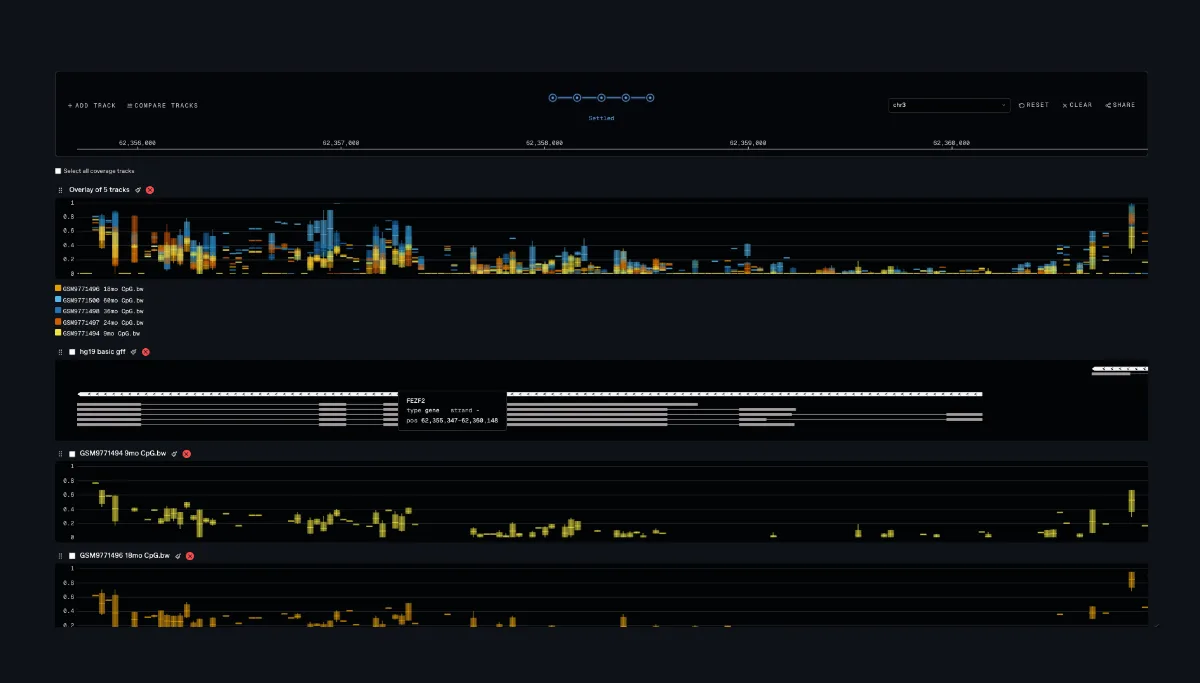
Nurture is building the infrastructure for epigenomics: tools to read it, software to understand it, and systems to remodel it. Tellus is in beta. Request access if you want to run your own data through it.