Introducing Nurture: Accelerated Adaptation
The nature of a living thing is encoded in its genome. Written and rewritten by evolution, it is a palimpsest1 of past organisms’ preparation for the future.
Decoding the genome has proven to be an incredibly powerful means of understanding the nature of life: we can now read and rewrite genes to predict and reverse disease; it’s become trivial to manipulate genetic material to the point that we can bring species back from extinction2; and genomic foundation models are enabling us to jump the gap from sequence to function faster than ever3.
And yet, we all inherently know that while our genetic nature is carried in our DNA, we are shaped by our experiences and environment. We are molded by nurture.
Just as nature is encoded in the genome, nurture is encoded in the epigenome.
The epigenome, which can be thought of at the highest level as the shape and form of the DNA in a cell, is one of the most important layers of biology, determining how living things adapt and respond to the world. It’s the layer where biology encodes change, yet it’s largely stayed out of reach because the tools to read, understand and remodel it have never existed in one place.
We started Nurture to build that place, so biology’s most powerful layer can become actionable. By remodeling what life remembers and how it reacts, we can shape how it adapts. For the stability of our planet, its ecosystems and human well-being, we believe the time to build towards designable, accelerated adaptation is now.
The epigenome is a uniquely complex problem space, where each adapted quality is the result of many degrees of freedom clicking into place. It’s temporally dependent, with many epigenomic marks tied to the internal “clocks” of how living things respond to day and night and the processes of aging. The beautiful plasticity of this system is what enables a caterpillar to have the same genome as a butterfly and a muscle cell the same genome as a brain cell. It is also the reason the epigenome is challenging to work in. While some changes to the epigenomic landscape result in dramatic biological change, most are absorbed by the combinatorial complexity of the system. We think models and data that find these key points of peak potential in the landscape are one of the largest opportunities in the space.
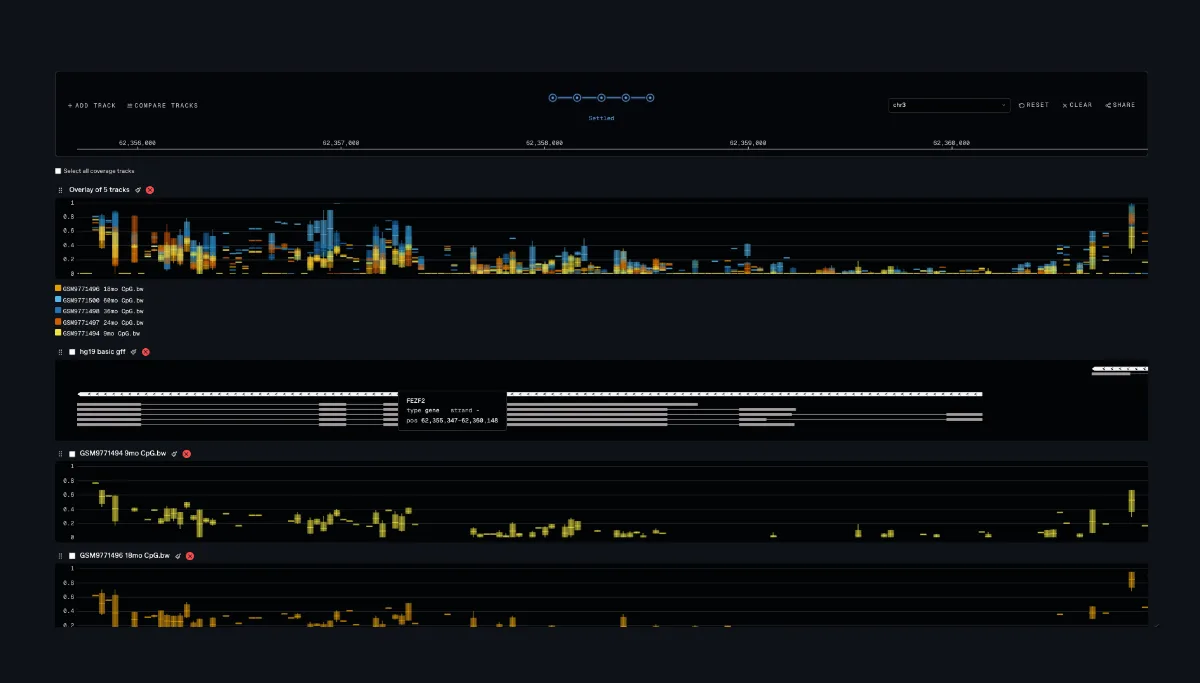
Tellus, our first product, is built for deriving insight from combinatorial epigenomic data, letting scientists work with complexity without having to wrangle it.
Today the epigenome can only be observed. Tellus is the first layer in a suite of epigenomic tooling that will make it actionable. In time, the epigenome becomes designable. By remodeling what life already remembers, we can shape how it adapts. That’s accelerated adaptation.
Footnotes
-
A metaphor borrowed from The Genetic Book of the Dead, Richard Dawkins. ↩
-
See the groundbreaking work of Colossal Biosciences. ↩
-
A reference to the Arc Institute’s Evo 2 foundational model. ↩
Nurture is building the infrastructure for epigenomics: tools to read it, software to understand it, and systems to remodel it. Tellus is in beta. Request access if you want to run your own data through it.